From Single-cell Proteomics to the Next Milestones in Protein Quantification and Analysis
A recent Nature Technology Feature traces the remarkable development of single-cell proteomics, from a technology that was once considered nearly impossible to a field in which it is possible to measure thousands of proteins from individual cells.
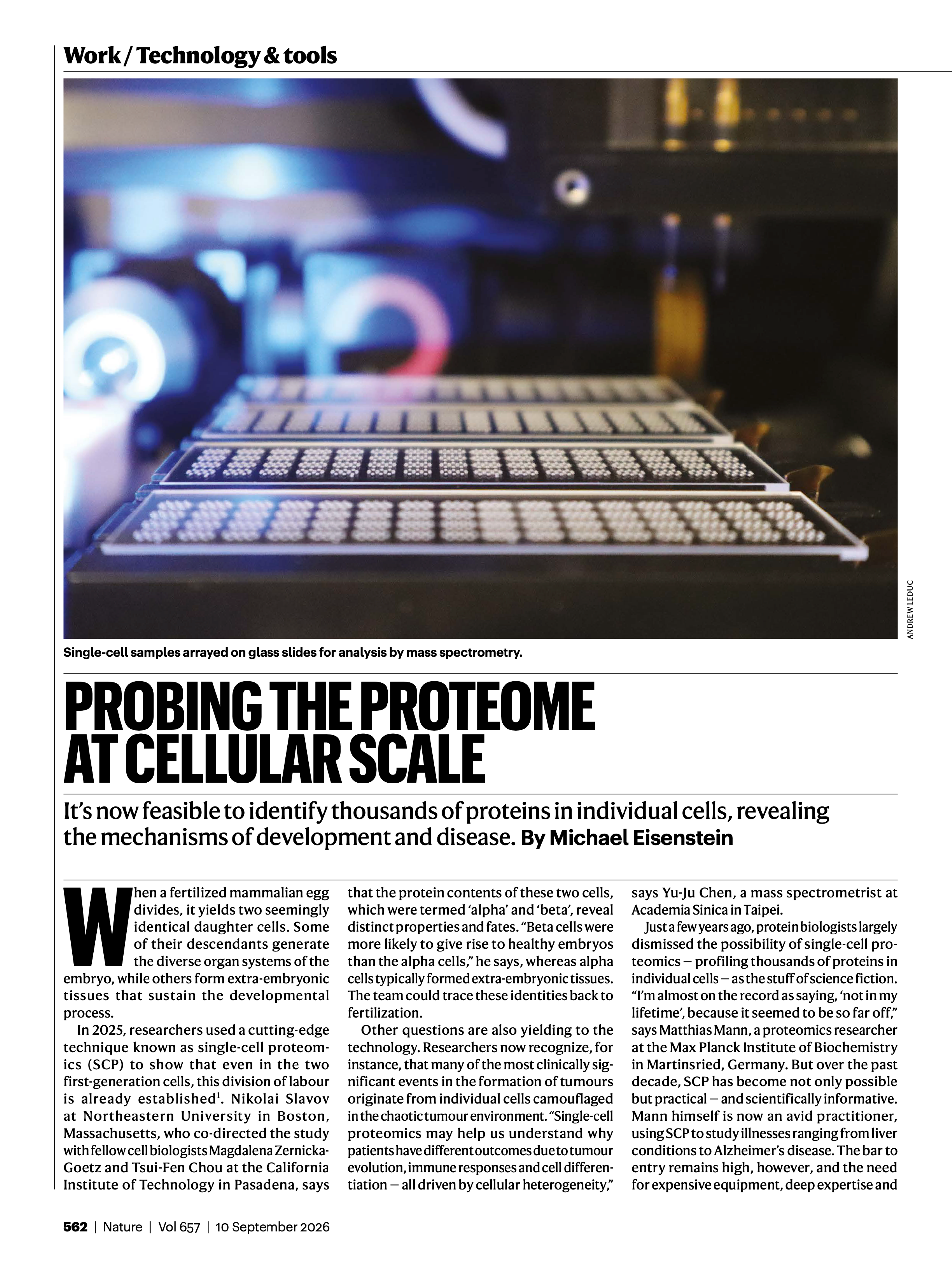
A recent Nature Technology Feature, Probing the proteome at cellular scale, traces the remarkable development of single-cell proteomics—from a technology that was once considered nearly impossible to a field in which it is possible to measure thousands of proteins from individual cells. The article highlights the pioneering work from our team that demonstrated that meaningful proteomic measurements could be made from single mammalian cells. This work helped establish a new field; subsequent advances in sample preparation, mass spectrometry, multiplexing, and computational analysis have rapidly increased both the depth and scale of these experiments.
A next major challenge for this field will be to achieve high throughput without sacrificing quantitative accuracy. Most single-cell proteomics workflows are unable to analyze more than a few hundred cells per day, which is far below the scale routinely achieved by single-cell transcriptomics. As Michael Eisenstein notes in this Nature Technology Feature, multiplexing offers a path forward, but increasingly dense spectra also create major challenges for identifying and accurately quantifying peptides.
At Parallel Squared Technology Institute, we are developing new methods to overcome this limitation. Our recent preprint, JMod: Joint modeling of mass spectra for empowering multiplexed DIA proteomics, introduces open-source software that jointly models overlapping signals in highly multiplexed DIA spectra. JMod enables 9-plexDIA with only 2-Da mass offsets, increasing acquisition throughput nine-fold while preserving quantitative accuracy and proteome coverage. It also supports multiplexing in both the mass and time domains, creating a foundation for substantially greater throughput in sensitive proteomics.
Importantly, these technological advances are uncovering new biological discoveries—it is not simply increasing the amount of proteomic data that can be obtained. Using multiplexed metabolic labeling and JMod, we measured protein synthesis and degradation rates in individual mouse liver cells. We found that spatial protein gradients across the liver are often shaped by spatially regulated protein degradation, rather than by differences in RNA abundance. For example, the lipid-transfer protein Mttp increases from portal to central hepatocytes because it is degraded more rapidly in portal cells and more slowly in central cells. Across functional categories, spatially patterned protein half-lives closely tracked protein abundance, revealing protein stability as a systematic mechanism for sculpting tissue architecture.
This illustrates the broader opportunity: as single-cell proteomics becomes deeper, more accurate, and more scalable, it will move beyond describing cellular states to directly measuring the molecular processes that lead to those states and explain how homeostasis is disrupted, resulting in disease states.
We are also delighted to welcome Joshua Finkelstein as PTI’s Chief of Staff. He was a senior editor and team leader at Nature from 2004–2016, and he has spent the past 11 years at two R1 universities in the greater Boston area. At those universities, he worked closely with the faculty directors of research centers to develop and implement the centers’ strategic plans and achieve their long-term goals. Joshua brings substantial scientific, strategic, and organizational experience that will strengthen our growing team and help us translate our ambitious technological and biological initiatives into successful, impactful outcomes.
The history of single-cell proteomics shows what can happen when a seemingly impossible measurement becomes technically feasible. At PTI, we are working toward the next step: making direct protein measurements vastly more scalable while preserving their depth, accuracy, and biological information.